Extra Fine Merino Wool vs Cashmere: Choosing Cold-Weather Knitwear
When packing knitwear for coastal travel or cooler weather, two animal fibers stand out: extra fine merino wool and cashmere. Both provide natural warmth, breathe well, and drape softly against the skin, yet their yarn structures behave differently under changing temperatures and daily wear.
Understanding fiber micron width, yarn density, and garment construction makes it simple to choose between them. For autumn breezes, coastal mornings, and cool evenings, our men's knitwear collection brings together extra fine merino wool and soft knit blends finished in small-batch garment dyes.
Here is how extra fine merino wool and cashmere compare across softness, thermal insulation, resistance to pilling, and travel ease.
Fiber Diameter and Handfeel
The softness of wool depends primarily on the micron rating of the fiber. One micron equals one thousandth of a millimeter. Standard sheep wool measures between 25 and 32 microns, which can feel prickly against sensitive skin.
Extra fine merino wool comes from merino sheep bred for exceptionally slender fleece, typically measuring between 18.5 and 19.5 microns. Because these fibers bend readily upon contact with skin, high-grade merino wool feels remarkably soft and non-scratchy.
Cashmere comes from the soft undercoat of cashmere goats, with fibers measuring between 14 and 16 microns. This ultra-fine diameter gives cashmere its distinct lofty cushion and cloud-like surface touch. While cashmere delivers an unmatched immediate softness, high-micron merino wool offers a clean, supple hand that sits smooth and flat without prickle.
Warmth, Weight, and Layering
Both fibers are crimped natural insulators. Their curly microscopic structure traps millions of tiny pockets of air, retaining body warmth while allowing moisture vapor to escape.
Cashmere fibers hold higher natural loft per gram, delivering substantial warmth at minimal weight. A thin cashmere sweater can insulate as effectively as a much heavier lambswool pullover. This makes cashmere ideal for brisk, dry winter air where soft, lofty insulation is preferred.
Extra fine merino wool has higher natural elasticity and tensile resilience. Merino knits adapt effortlessly to changing weather. When walking into a warm cafe or stepping out onto a breezy boat deck, merino wool actively regulates body heat, wicking away perspiration before dampness can form. For traveling across varied microclimates or layering under jackets and unlined blazers, merino offers exceptional temperature control without overheating.
Durability and Pilling Resistance
Every fine animal fiber sheds short surface strands during wear, leading to tiny clusters known as pilling. Pilling happens when friction rubs loose fiber ends into balls, especially under arms and across waistlines.
Cashmere fibers are shorter and softer than sheep wool. As a result, cashmere knitwear naturally pills during its first few wears and requires gentle combing with a cashmere brush to maintain a smooth surface.
Merino wool fibers are longer, stronger, and more resilient. The natural spring-like crimp allows merino yarns to stretch and snap back into place during movement. An extra fine merino wool sweater withstands frequent folding, travel bags, and daily wear with minimal pilling, holding its clean stitch definition and crisp shape over seasons of wear.
Garment-Dyed Color Depth
At Ploumanac'h, we knit our garments before dyeing them. Dyeing assembled sweaters allows colors to soak deep into seams, ribbed cuffs, and collars, creating subtle tonal variations that raw yarn dyeing cannot replicate.
Merino wool absorbs garment dye with rich clarity. Whether dyed in deep coastal tones like Mosto or mineral shades like Volcanic, merino yarns highlight the natural texture of the stitch. Proprietary treatments like our Rock Art wash add distinct mineral shading, echoing the tones of weathered rocks along the shore.
Cold-Weather Knitwear for Travel
For a balanced winter packing list, both fibers hold a place:
- Choose Cashmere when maximum loft and cloud-like softness are your priority for restful evenings and cold, dry days.
- Choose Extra Fine Merino Wool when you need versatile warmth, packability, crease resistance, and resilient all-day wear that layers cleanly under a coat.
Men's knitwear sweaters to wear
Explore our full selection in the men's knitwear collection.
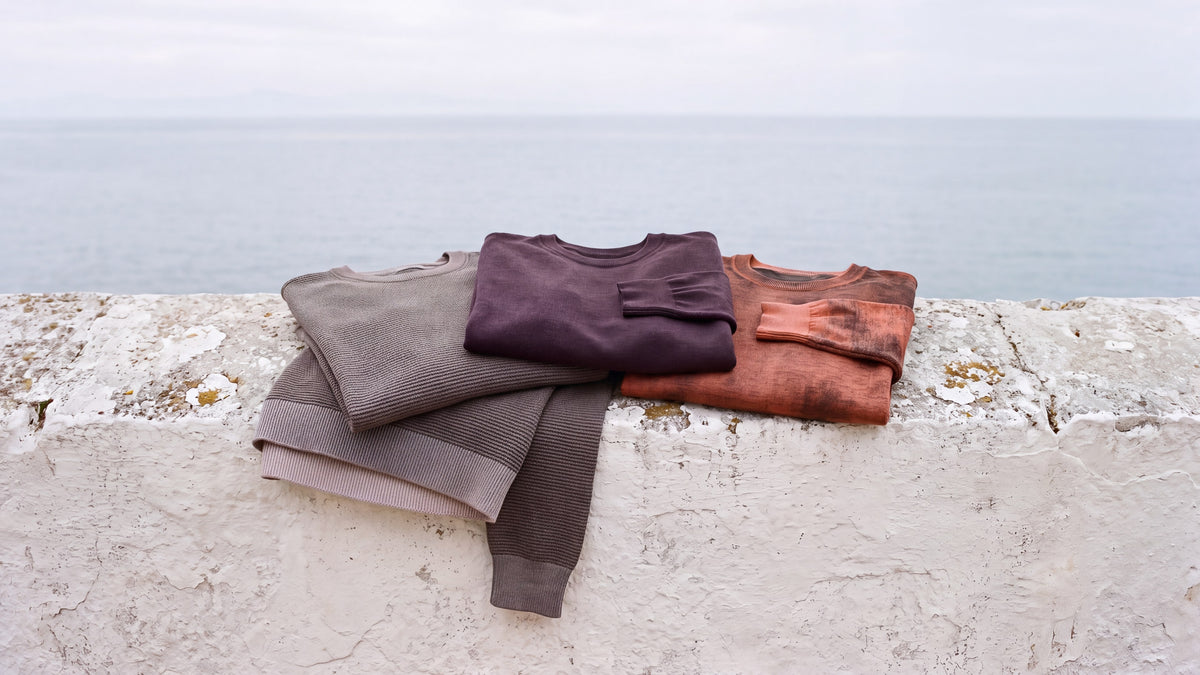
- Balmoral in Mosto: Extra fine merino wool crewneck sweater with ribbed collar and cuffs, dyed in a deep grape tone.
- Dorset in Cliff: Lightweight merino wool crewneck with a supple knit handle, garment-dyed in coastal grey-blue.
- Gills Rock Art in Volcanic: Textured merino wool knit finished with mineral shading along the seams and edges.
Receive updates on new knitwear arrivals, garment-dye techniques, and seasonal color editions by joining our newsletter below.